Adaptive Step-Size Selection#
So far we’ve mostly used a fixed step size, \( t_n - t_{n-1} = \Delta t \) . In practice a fixed choice is often sub-optimal: varying the step size can give much more efficient algorithms.
As an example, take the stiff ODE
\[\dv{u}{t} = -100 \left( u - \sin(t) \right) \qquad u(0) = 1\]and suppose we want to solve it with forward Euler. Because the problem is stiff, we need a very small \( \Delta t \) at the beginning, but later the solution is nice and smooth and a much larger \( \Delta t \) would do.
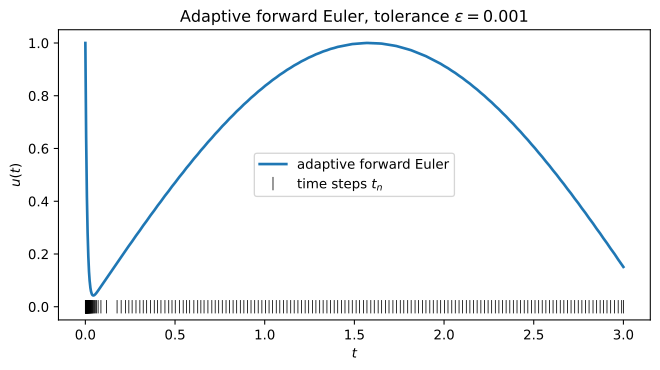
Forward Euler with adaptive step sizes chosen to keep the local truncation error below \( 10^{-3} \). Tick marks show the time steps \( t_n \): very dense through the initial transient, sparse afterwards.
The trick is to let the update rule use a different step size at each step,
\[u_{n+1} = u_n + \Delta t_n f_n\]which is simple enough. The important question is: how should we choose \( \Delta t_n \)?
Estimating the Truncation Error#
A simple approach is to estimate the local truncation error of the method and keep it below a tolerance. For forward Euler, Taylor’s theorem gives
\[u(t_{n+1}) - u(t_n) - \Delta t_n f(t_n, u(t_n)) = \frac{\Delta t_n^2}{2} u''(\xi) \qquad \xi \in [t_n, t_{n+1}]\]We can’t evaluate \( u’’ \) directly, but we can approximate it with a difference of first derivatives, which we can evaluate since \( u’ = f \):
\[u''(\xi) \approx \frac{1}{\Delta t_n} \Big( u'(t_{n+1}) - u'(t_n) \Big) = \frac{1}{\Delta t_n} \Big( f(t_{n+1}, u(t_{n+1})) - f(t_n, u(t_n)) \Big)\]So for the numerical solution, we choose \( \Delta t_n \) such that
\[\frac{\Delta t_n}{2} \left| f_{n+1} - f_n \right| \leq \text{TOL}\]This is efficient: if the proposed \( \Delta t_n \) is accepted, we already have \( f_{n+1} \) for the next forward Euler step at no extra cost.
Updating the Step Size#
There are many strategies for adapting \( \Delta t_n \), mostly beyond the scope of the course. A simple one: start from the error estimate
\[\text{ERROR} = \frac{[\Delta t_n]_{\text{old}}}{2} \left| f_{n+1} - f_n \right| \approx C \, [\Delta t_n]_{\text{old}}^2\]where \( [\Delta t_n]_{\text{old}} \) is the step size we just tried. This lets us estimate \( C = \text{ERROR} / [\Delta t_n]_{\text{old}}^2 \) . We want the new step to hit the tolerance, \( C \, [\Delta t_n]_{\text{new}}^2 = \text{TOL} \) , so
\[[\Delta t_n]_{\text{new}} \leftarrow \left( \frac{\text{TOL}}{C} \right)^{1/2} = [\Delta t_n]_{\text{old}} \left( \frac{\text{TOL}}{\text{ERROR}} \right)^{1/2}\]We iterate this until \( \Delta t_n \) passes the tolerance test. The formula lets \( \Delta t_n \) naturally decrease, but also increase when the error is much smaller than the tolerance. In practice we add a safety factor \( s \in (0, 1] \),
\[[\Delta t_n]_{\text{new}} \leftarrow s \cdot [\Delta t_n]_{\text{old}} \left( \frac{\text{TOL}}{\text{ERROR}} \right)^{1/2}\]so the next attempt lands a bit under the tolerance rather than right at it.
\begin{algorithm}
\caption{Adaptive Forward Euler}
\begin{algorithmic}
\State Given $c$, $f$, $T$, $\text{TOL}$, safety factor $s$, initial step $\Delta t$
\State Set $t = 0$, $u = c$, $f_{\text{old}} = f(0, c)$
\While{$t < T$}
    \State Set $\Delta t = \min(\Delta t, T - t)$
    \State Set $u_{\text{new}} = u + \Delta t \, f_{\text{old}}$
    \State Set $f_{\text{new}} = f(t + \Delta t, u_{\text{new}})$
    \State Set $\text{ERROR} = \frac{\Delta t}{2} |f_{\text{new}} - f_{\text{old}}|$
    \If{$\text{ERROR} \le \text{TOL}$}
        \State Accept: $t \gets t + \Delta t$, $u \gets u_{\text{new}}$, $f_{\text{old}} \gets f_{\text{new}}$
    \EndIf
    \State Set $\Delta t \gets s \cdot \Delta t \, (\text{TOL} / \text{ERROR})^{1/2}$
\EndWhile
\end{algorithmic}
\end{algorithm}
The step size is updated whether or not the step was accepted: a rejected step retries with a smaller \( \Delta t \), and an accepted step with a small error lets the next step grow. The course notebook uses \( s = 0.9 \), and also clamps each update to between \( 0.2\times \) and \( 2\times \) the old step so \( \Delta t \) can’t change too abruptly. With \( \text{TOL} = 10^{-3} \) on \( [0, 3] \), it takes 194 accepted steps (plus 61 rejected attempts), ranging from \( \Delta t = 4 \times 10^{-4} \) in the transient to \( 5.9 \times 10^{-2} \) afterwards. A uniform step small enough for the transient would need about 7,500 steps.